
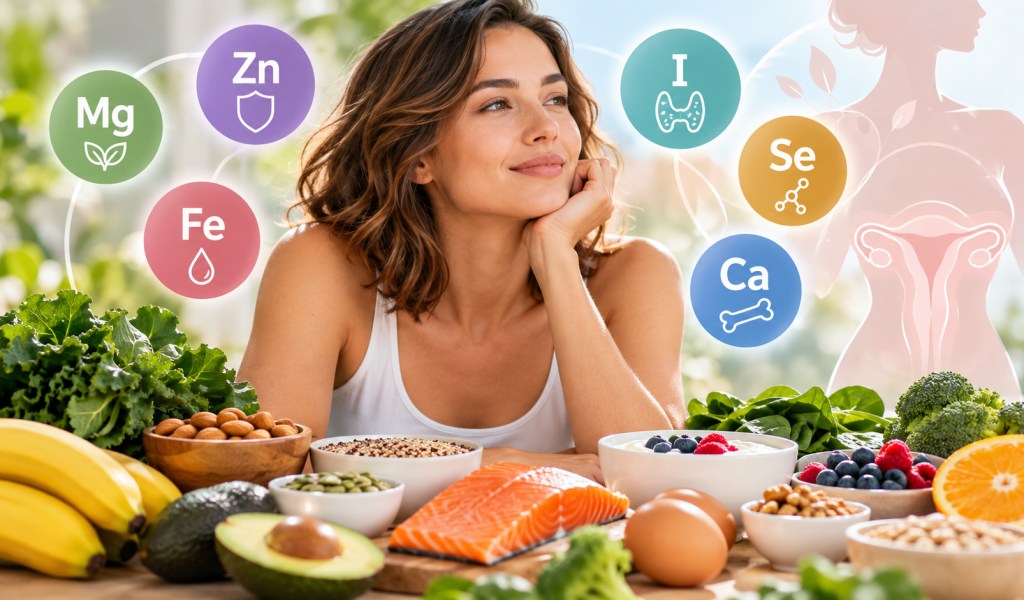


Hormones influence almost every stage of a woman’s life.
They help regulate menstrual cycles, ovulation, fertility, metabolism, blood sugar, thyroid function, bone health, mood, pregnancy, and eventually the transition through perimenopause and menopause.
Because hormones play such a large role in women’s health, the phrase “hormonal balance” has become extremely popular.
You may see advertisements claiming that magnesium will “balance your hormones,” zinc will “fix estrogen,” or a special mineral supplement will reset your entire endocrine system.
The truth is more complicated.
Your body absolutely needs certain minerals to produce hormones, respond to hormones, and carry out the biological processes that hormones control. But there is no single mineral—or supplement—that can automatically correct every hormonal problem.
The best approach is to consume adequate amounts of essential nutrients through a varied diet, identify actual deficiencies when they occur, and seek medical care when symptoms suggest an underlying hormonal condition.
Here are some of the minerals that are particularly important for women’s hormonal and metabolic health.
Magnesium: Important for Hundreds of Body Processes
Magnesium is one of the most talked-about minerals for women’s health—and for good reason.
Your body uses magnesium as a helper, or cofactor, in more than 300 enzyme systems. These systems are involved in processes including protein production, nerve function, muscle function, blood pressure regulation, energy production, and blood glucose control.
For adult women, the recommended daily amount is generally about 310 to 320 milligrams, while needs rise during pregnancy.
Good food sources include beans, nuts, seeds, whole grains, leafy green vegetables, milk, and yogurt.
Because magnesium is involved in glucose metabolism, researchers have investigated its relationship with insulin resistance and type 2 diabetes. NIH notes that people who consume more magnesium in their diets tend to have a lower risk of developing type 2 diabetes, although this does not mean magnesium supplements are a treatment for every blood-sugar or hormonal problem.
This can be particularly relevant to women because insulin regulation is closely connected with metabolic health and conditions such as polycystic ovary syndrome.
But having fatigue, cravings, irregular periods, or difficulty losing weight does not automatically mean you need magnesium supplements.
Start by looking at your overall diet.
Our Healthy Diet for Women to Stay Fit guide can help you build meals containing a wider variety of nutrient-rich foods.
Iodine: Essential for Thyroid Hormones
If we are talking about minerals and hormones, iodine deserves special attention because the connection is extremely direct.
Your body needs iodine to produce the thyroid hormones thyroxine, or T4, and triiodothyronine, or T3.
These thyroid hormones help regulate metabolism and many other biochemical processes throughout the body.
Adults generally need about 150 micrograms of iodine per day. Requirements increase to 220 micrograms during pregnancy and 290 micrograms during breastfeeding.
Sources of iodine can include iodized salt, seafood, dairy products, eggs, and certain fortified foods.
Women who do not use iodized salt or who follow restrictive vegan or vegetarian diets may need to pay closer attention to iodine intake.
However, this is not a situation where more is always better.
Too little iodine can interfere with thyroid function, but too much iodine can also cause thyroid problems in susceptible people.
So if you have symptoms such as persistent fatigue, unusual weight changes, feeling unusually cold or hot, rapid heartbeat, neck swelling, or significant menstrual changes, do not simply begin taking high-dose iodine.
A thyroid evaluation is more useful than guessing.
Selenium: A Partner in Thyroid Hormone Metabolism
Selenium works closely with the thyroid as well.
The thyroid contains a higher concentration of selenium than any other organ in the body.
Selenium-containing proteins help convert the thyroid hormone T4 into the more active T3 and also help protect thyroid tissue from oxidative damage that occurs during thyroid-hormone production.
Selenium can be obtained from foods including seafood, meat, poultry, eggs, dairy products, grains, and Brazil nuts.
But selenium is a great example of why “good for hormones” should never become:
Take as much as possible.
Research has not shown that giving selenium supplements to everyone improves thyroid function. Studies involving thyroid disease and selenium supplementation have produced mixed results.
And excessive selenium intake can cause toxicity.
So rather than automatically buying a selenium supplement because you heard it supports thyroid hormones, aim to get adequate—not excessive—amounts.
Zinc: Important for Reproductive and Cellular Health
Zinc is involved in hundreds of enzyme reactions and plays important roles in DNA production, protein synthesis, cell division, immune function, wound healing, and normal growth and development.
It is also involved in the reproductive system. Severe zinc deficiency can affect reproductive function.
Adult women generally need about 8 milligrams of zinc per day, with higher requirements during pregnancy and breastfeeding.
Good sources include oysters and other seafood, meat, poultry, dairy foods, beans, nuts, and whole grains.
Women following vegetarian or vegan diets may need to be more deliberate about zinc because zinc from plant foods may be less readily absorbed.
You may see zinc supplements marketed as a way to “increase progesterone” or “balance estrogen.”
Those claims often go much further than the evidence.
Zinc is essential for normal physiology, but taking large amounts does not guarantee healthier hormone levels.
Excessive zinc can also interfere with copper absorption and create additional health problems.
The goal is adequate nutrition—not megadosing.
Iron: Especially Important for Menstruating Women
Iron may not immediately come to mind when you think about hormones, but it has an important place in women’s health.
The body needs iron to produce hemoglobin, which carries oxygen in the blood, and NIH notes that iron is also needed to produce some hormones.
Women who menstruate lose iron through blood loss.
That means women with particularly heavy periods can be at increased risk for iron deficiency. Pregnant women also have substantially greater iron requirements.
Iron-rich foods include meat, poultry, seafood, beans, lentils, fortified cereals, and leafy green vegetables.
If you eat plant-based sources of iron, pairing them with vitamin C-rich foods can improve absorption.
For example:
Lentils with bell peppers.
Spinach with strawberries.
Beans with tomatoes.
Our Foods to Buy for Healthy Eating guide can help you stock more nutrient-dense foods at home.
Heavy Periods and Iron Deserve Attention
If you experience very heavy menstrual bleeding along with fatigue, weakness, dizziness, shortness of breath, or difficulty concentrating, talk with a healthcare professional.
Do not simply take large amounts of iron without testing.
Iron is essential, but excessive supplemental iron can be harmful.
A healthcare professional can check measures such as hemoglobin and ferritin to determine whether iron deficiency may actually be present.
Calcium: Hormones and Bone Health Are Closely Connected
Calcium is usually discussed as a bone mineral, but it does much more.
The body uses calcium for muscle contraction, communication between nerves, blood-vessel function, and the release of hormones that affect many functions throughout the body.
Calcium becomes particularly relevant to women as estrogen levels decline during and after menopause.
Estrogen helps protect bone.
When estrogen declines, bone breakdown can accelerate, which contributes to the increased risk of osteoporosis later in life.
For most adult women ages 19 to 50, the recommended calcium intake is about 1,000 milligrams per day. Requirements increase for older women.
Food sources include milk, yogurt, cheese, fortified plant milks, tofu prepared with calcium, sardines with bones, and certain leafy green vegetables.
Vitamin D is also important because it helps the body absorb calcium.
This illustrates an important principle:
Nutrition rarely works one nutrient at a time.
Minerals, vitamins, hormones, proteins, enzymes, and other biological systems interact continuously.

Minerals Cannot Fix Every “Hormone Imbalance”
This is where women need to be cautious with social-media health advice.
Symptoms such as weight gain, acne, fatigue, irregular periods, difficulty sleeping, hair thinning, infertility, mood changes, and cravings are often labeled online as:
“Hormone imbalance.”
But these symptoms can have many different causes.
Irregular periods, for example, may occur with PCOS, thyroid disease, major weight changes, pregnancy, perimenopause, elevated prolactin, certain medications, or other conditions.
Fatigue could involve anemia, inadequate sleep, depression, thyroid disease, nutritional deficiency, medication effects, or dozens of other possibilities.
Taking magnesium, selenium, zinc, and iodine together will not automatically solve the underlying problem.
If symptoms persist, proper diagnosis matters.
Food First Is Usually a Smart Starting Point
Instead of immediately buying six supplements, look at what you routinely eat.
A varied eating pattern containing vegetables, fruits, whole grains, beans, seafood, eggs, dairy or fortified alternatives, lean proteins, nuts, and seeds can provide many of these minerals simultaneously.
One meal might contain:
Salmon for selenium and other nutrients, brown rice for magnesium, leafy vegetables for magnesium and iron, and yogurt for calcium.
Another could combine lentils, vegetables, whole grains, pumpkin seeds, and fruit.
You do not have to create a “hormone-balancing plate.”
You need an overall eating pattern that consistently provides your body with adequate nutrition.
Do You Need Mineral Supplements?
Sometimes.
A supplement can be useful when someone has:
A diagnosed nutritional deficiency, increased requirements, limited dietary intake, absorption problems, pregnancy-related needs, or another medical reason for supplementation.
But supplementing without knowing what you need can create problems.
Minerals can interact with one another.
Large amounts of zinc can affect copper.
Calcium can interfere with the absorption of certain medications.
Iron can interact with medications and can be toxic in excessive amounts.
Too much iodine can disturb thyroid function.
Too much selenium can produce toxicity.
This is why “hormone supplements” containing large combinations of minerals are not automatically better than a balanced diet.
If you take prescription medications or have thyroid disease, kidney disease, anemia, PCOS, or another medical condition, discuss supplements with your healthcare professional.
Personalizing Your Nutrition
Two women can have completely different nutritional needs.
One woman may have heavy menstrual periods and iron deficiency.
Another may avoid dairy and need to pay closer attention to calcium.
Another follows a vegan diet and needs to think more carefully about iodine and zinc.
Another may already get plenty of these nutrients through food and need no additional supplements at all.
That is one reason generic meal plans can fall short.
If you want help creating an eating and fitness routine around your individual goals, schedule, food preferences, and lifestyle, you can learn more about our Custom Women’s Diet & Fitness Plan.
A personalized nutrition plan should complement appropriate medical care—not replace diagnosis or treatment for a hormonal disorder.
The Bottom Line
Minerals are essential for women’s hormonal health, but the phrase “hormonal balance” can sometimes make nutrition sound much simpler than it really is.
Magnesium contributes to hundreds of biochemical reactions and supports blood glucose regulation.
Iodine is directly required to produce thyroid hormones.
Selenium helps the body produce and metabolize thyroid hormones.
Zinc supports normal cellular and reproductive function.
Iron helps transport oxygen and is needed in the production of some hormones.
Calcium participates in hormone release and becomes particularly important for women’s bone health as estrogen declines with age.
These nutrients matter.
But more is not automatically better.
You do not need to swallow handfuls of supplements simply because you have:
Fatigue.
Acne.
Cravings.
Weight changes.
Irregular periods.
Hair problems.
Or mood changes.
Those symptoms deserve proper evaluation when they persist.
Start with the foundation:
Eat a varied, nutrient-rich diet.
Include adequate protein.
Eat vegetables and fruits.
Choose whole grains, beans, nuts, seeds, dairy or appropriate fortified alternatives, seafood, and other nutrient-dense foods.
Have suspected deficiencies properly evaluated.
And use supplements strategically when they are actually needed.
Hormonal health is influenced by much more than one mineral.
Your nutrition, sleep, physical activity, medical conditions, medications, age, genetics, stress, reproductive stage, and overall health all contribute.
The goal is not to chase the latest “hormone-balancing” supplement.
It is to give your body the nutrients it needs while addressing genuine hormonal problems with appropriate medical care.
This article is for general educational purposes and is not intended to diagnose or treat hormonal disorders or nutritional deficiencies. If you have persistent menstrual changes, unexplained weight changes, fertility concerns, thyroid symptoms, severe fatigue, or other symptoms that concern you, speak with a qualified healthcare professional before beginning high-dose mineral supplements.