


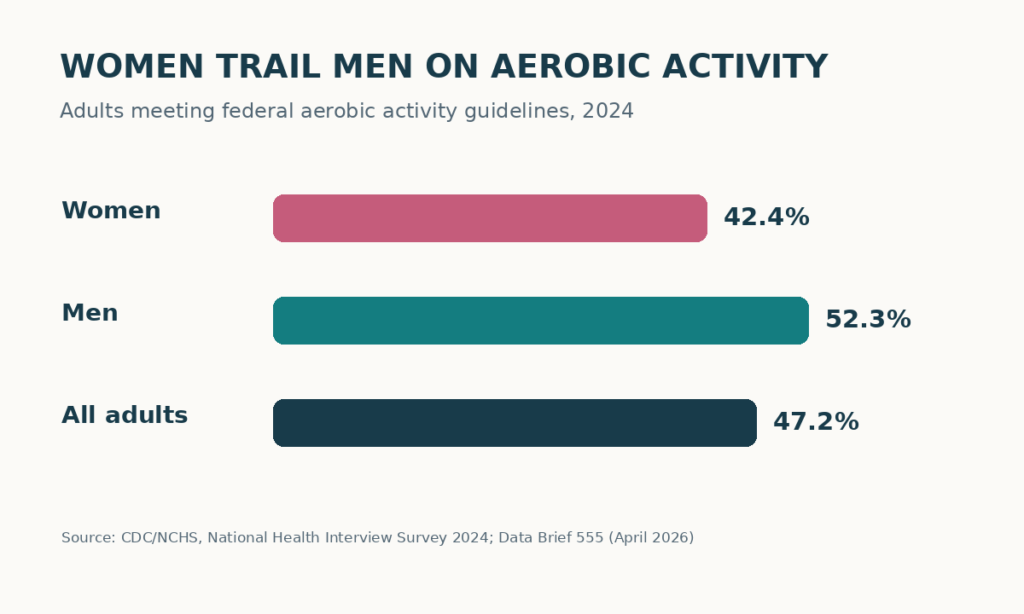
Only 42.4% of U.S. women met federal leisure-time aerobic activity guidelines in 2024, compared with 52.3% of men, according to a CDC analysis.
A national CDC report released in April 2026 highlights a nearly ten-percentage-point difference between women and men in meeting federal aerobic exercise recommendations. Based on the 2024 National Health Interview Survey, 42.4% of women ages 18 and older reported enough leisure-time aerobic activity to meet the guidelines, compared with 52.3% of men.
For Women’s Health & Diet, the figures offer a useful reminder that exercise advice needs to account for real-world barriers and different starting points. The report measures reported activity, not women’s motivation or commitment, and does not explain the reasons for the difference.
- 42.4% of women met the aerobic activity recommendation, versus 52.3% of men—a 9.9-percentage-point gap.
- 47.2% of all adults met the aerobic recommendation in 2024.
- Across all adults, the percentage meeting the guideline fell from 54.0% among ages 18–34 to 38.4% among those 65 and older.
- Adults with disabilities were less likely to meet the recommendation (22.4%) than adults without disabilities (49.8%).
- The report assesses leisure-time aerobic activity; it does not separately estimate women’s occupational or household physical activity.
Source: CDC National Center for Health Statistics, National Health Interview Survey 2024, Data Brief No. 555, published April 2026.
What the CDC’s gender gap actually shows
The 9.9-percentage-point gap compares self-reported leisure-time activity against federal aerobic guidelines. The CDC found the difference between women and men was statistically significant. It is not a direct measurement of physical fitness, total daily movement, or how many women exercise at all: someone may be active but fall below the guideline threshold.
How much aerobic activity is recommended?
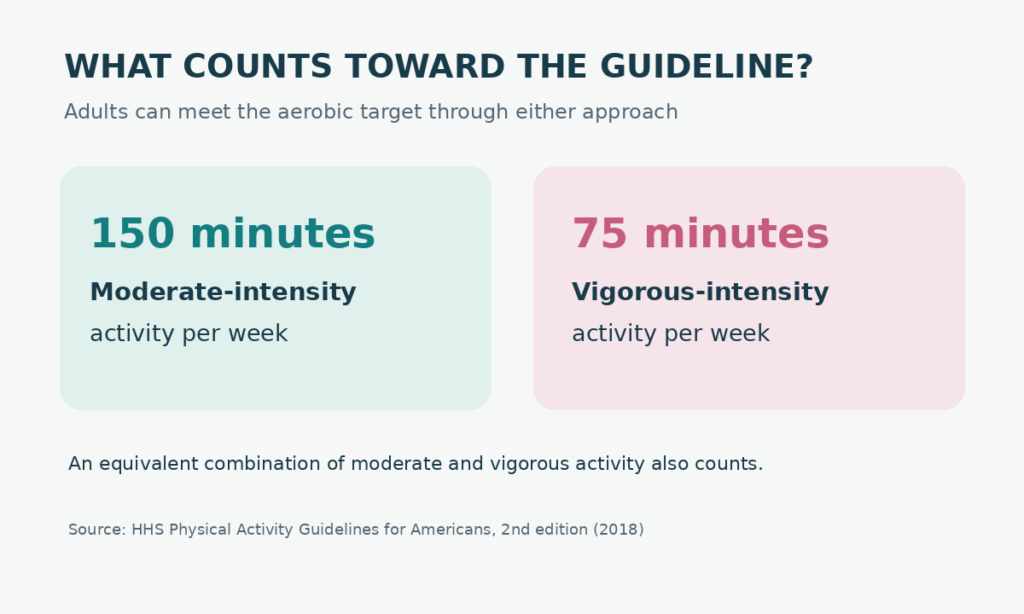
Federal guidance recommends adults aim for at least 150–300 minutes of moderate-intensity aerobic activity per week, or 75–150 minutes of vigorous-intensity activity, or an equivalent combination. Brisk walking is one accessible example of moderate-intensity movement for many people. Activity can be accumulated over the week rather than completed in one session. People managing health conditions or disabilities may need individualized advice and accessible adaptations.
Age, income and accessibility matter
Across all adults—not women alone—the CDC documented lower rates of meeting aerobic guidelines in older age groups and among people with disabilities. The analysis also found differences by income, education and region. These patterns should not be interpreted as proof that any one factor causes low activity levels. They reinforce the importance of discussing affordability, time, accessibility and safe places to move when recommending exercise.
Practical ways to build a routine
For someone starting below the recommended level, a manageable first step could be a short walk or another suitable activity on several days each week, increasing duration gradually as appropriate. A plan should account for personal preferences, mobility, health conditions and schedule. The CDC figures describe a population-level pattern, not a prescription for any individual.
Get a personalized Women’s Health & Diet plan designed around your goals, schedule, food preferences, and fitness level.
About the Data
This article summarizes the CDC National Center for Health Statistics Data Brief No. 555, released in April 2026, using 2024 National Health Interview Survey data. NHIS is a nationally representative household survey of the U.S. civilian, noninstitutionalized population. Estimates are based on self-reported leisure-time moderate and vigorous aerobic activity; the analysis accounts for the survey’s complex sample design. The sex estimates are 42.4% for women (95% confidence interval 41.3%–43.4%) and 52.3% for men (51.1%–53.5%). These are observational, cross-sectional survey estimates; they cannot establish causes or individual health outcomes. The survey does not measure all forms of daily physical activity or muscle-strengthening adherence in this headline comparison.
Sources
- CDC/NCHS: Aerobic Physical Activity Among Adults Age 18 and Older: United States, 2024 (Data Brief 555; April 2026)
- U.S. Department of Health and Human Services: Physical Activity Guidelines for Americans
About Women’s Health & Diet: Women’s Health & Diet publishes practical, evidence-informed information about women’s nutrition, fitness and wellness.