


New federal nutrition data show a measurable sex gap in fruit consumption among U.S. adults, with women more likely than men to report eating fruit on a given day.
A September 2026 National Center for Health Statistics report using National Health and Nutrition Examination Survey data found that 73.5% of women age 20 and older consumed any fruit on a given day during August 2021-August 2023, compared with 66.1% of men. The report provides a timely snapshot of what Americans actually reported consuming rather than a measure of whether individuals met recommended intake amounts.
The difference also appeared in several whole-fruit categories, making the new release useful for journalists, nutrition professionals and wellness organizations tracking dietary patterns.
- 73.5% of women consumed any fruit on a given day, compared with 66.1% of men.
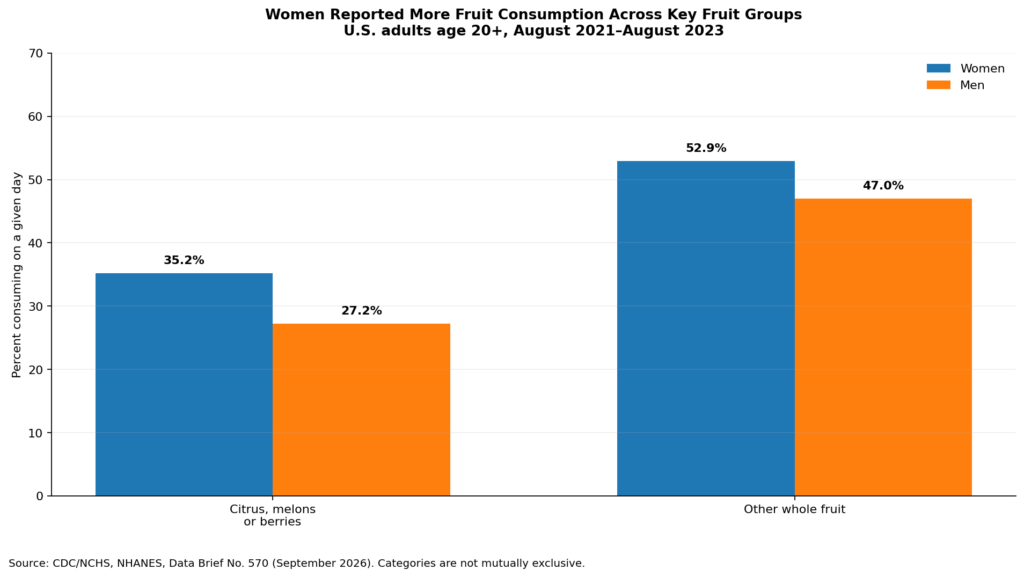
- 35.2% of women consumed citrus, melons or berries, versus 27.2% of men.
- 52.9% of women consumed other whole fruit, compared with 47.0% of men.
- There was no statistically significant sex difference in consumption of 100% fruit juice.
- Across all adults age 20 and older, 69.9% consumed any fruit on a given day.
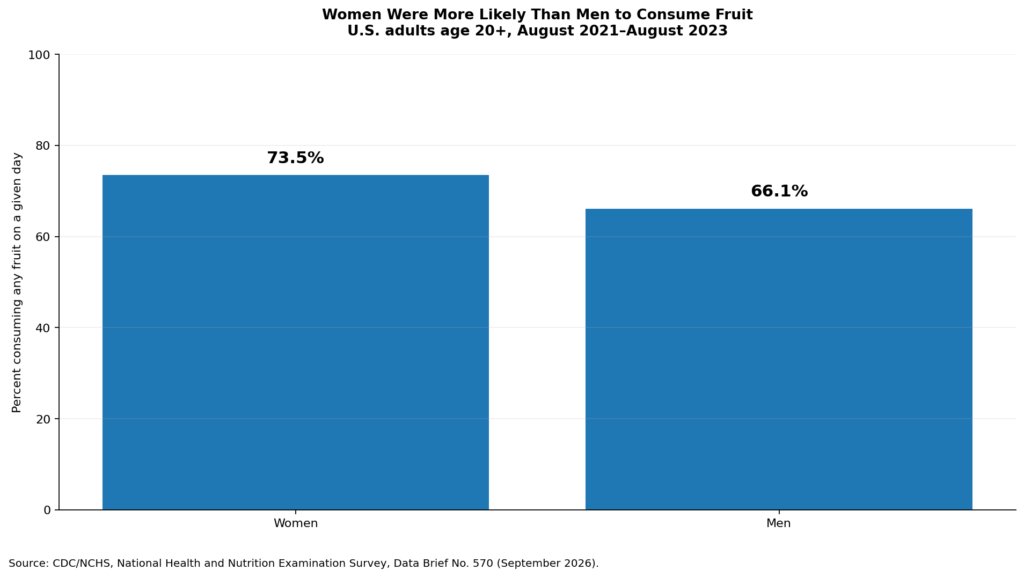
Source: National Center for Health Statistics, National Health and Nutrition Examination Survey, August 2021-August 2023; NCHS Data Brief No. 570, September 2026.
The Fruit Gap Was Larger for Some Whole-Fruit Categories
The overall difference between women and men was 7.4 percentage points. The CDC report also found higher percentages among women for citrus, melons or berries and for other whole fruit. These results describe population-level consumption on a given day and should not be interpreted as showing that every woman eats more fruit than every man.
Fruit Juice Did Not Show the Same Significant Difference
For 100% fruit juice, the estimates were 32.8% for women and 29.0% for men, but the report found no statistically significant difference by sex. That distinction matters: numerical differences in survey estimates are not automatically evidence of a reliable population difference.
Income Was Also Linked With Fruit and Vegetable Consumption
NCHS reported that the percentage of adults consuming any fruit, citrus, melons or berries, and other whole fruit increased with family income. Several vegetable categories showed a similar income pattern. The report is descriptive, so it does not establish why those differences exist or prove that income itself caused them.
What the New Numbers Mean for Practical Wellness
The findings offer a current benchmark for dietary behavior in U.S. adults. They can help frame discussions about access, food habits and nutrition outreach, but they are not a diagnosis or an individual dietary prescription. A one-day dietary recall is best understood as a tool for estimating population patterns rather than judging any one person’s usual diet.
Get a personalized Women’s Health & Diet plan designed around your goals, schedule, food preferences, and fitness level.
About the Data
The figures come from NCHS Data Brief No. 570, published in September 2026, using data from the National Health and Nutrition Examination Survey collected during August 2021-August 2023. The fruit analysis included 4,798 adults age 20 and older: 2,115 men and 2,683 women. NHANES dietary information in this report was based on a 24-hour dietary recall, and estimates were weighted to represent the U.S. civilian noninstitutionalized population. The analysis describes the percentage who consumed specified fruit and vegetable categories on a given day. It does not measure whether each participant met recommended daily intake, establish usual intake for an individual, or prove causes for differences by sex or income.
Sources
- National Center for Health Statistics: Fruit and Vegetable Consumption Among Adults: United States, August 2021-August 2023
- CDC: National Health and Nutrition Examination Survey (NHANES)
About Women’s Health & Diet: Women’s Health & Diet publishes practical, evidence-informed nutrition, fitness and wellness content for women, including research-driven insights designed to make public health data easier to understand and use.