



New analysis of federal survey data highlights a gap in sleep quality: women and men report similar rates of short sleep, but women are more likely to struggle with falling asleep, staying asleep, and waking refreshed.
How long someone sleeps does not tell the whole story. In the CDC’s National Center for Health Statistics (NCHS) April 2026 analysis of the 2024 National Health Interview Survey, women were more likely than men to report frequent sleep difficulties, even though the percentages reporting fewer than seven hours of sleep were nearly identical.
For women, the findings underscore why conversations about sleep health should go beyond a single question about nightly hours. The report describes national patterns, not the causes of any individual’s sleep problems.
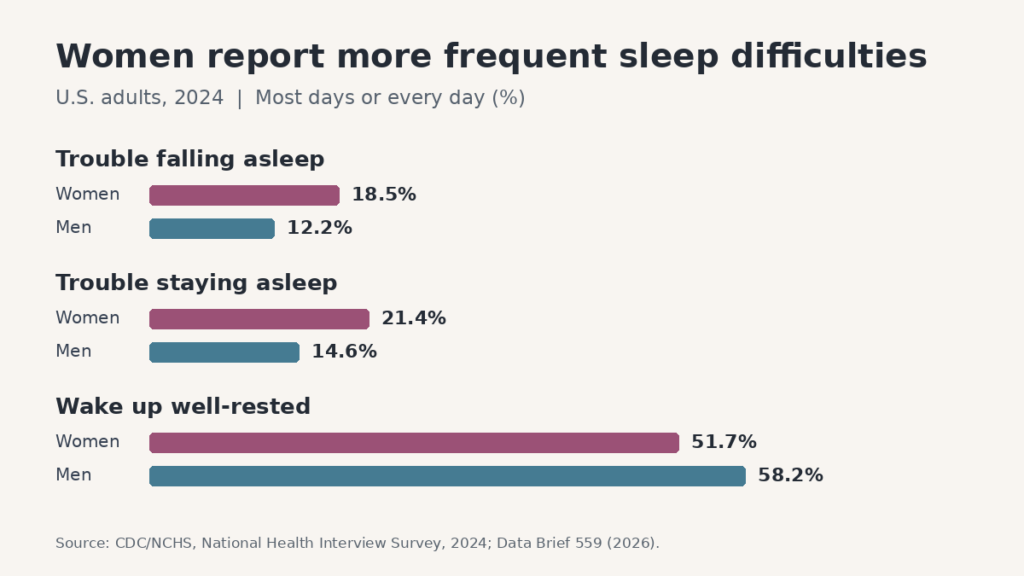
- 18.5% of women reported trouble falling asleep most days or every day, compared with 12.2% of men.
- 21.4% of women reported trouble staying asleep most days or every day, compared with 14.6% of men.
- 51.7% of women woke feeling well-rested most days or every day, compared with 58.2% of men.
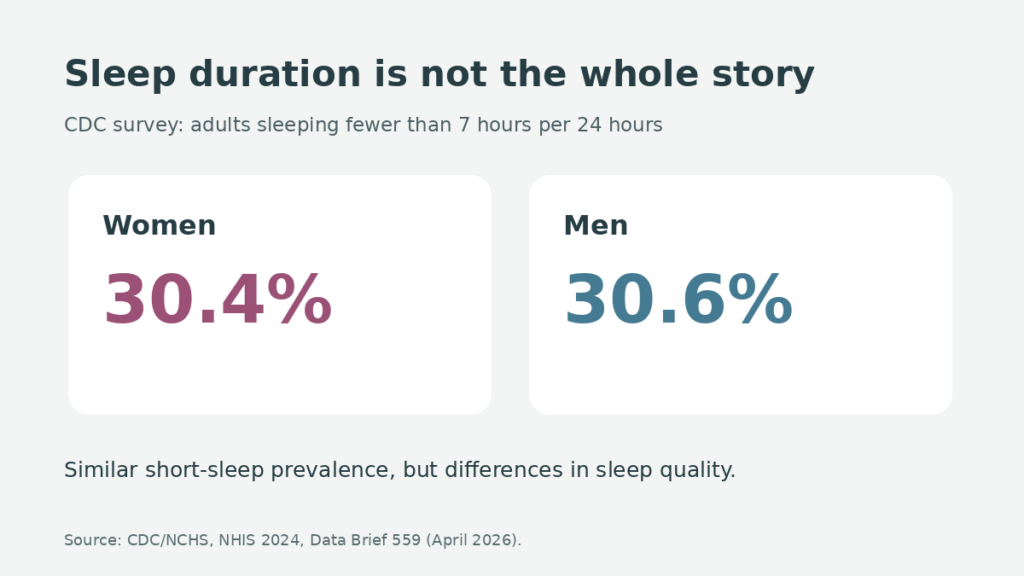
- Short sleep duration was similar: 30.4% of women and 30.6% of men reported fewer than seven hours per 24 hours.
- Across all adults, 30.5% reported fewer than seven hours of sleep.
Source: CDC National Center for Health Statistics, National Health Interview Survey 2024, Data Brief No. 559 (published April 2026). Estimates are survey-based.
Women Report More Difficulty Falling and Staying Asleep
The largest takeaway is not that women sleep dramatically fewer hours. It is that women reported more frequent trouble initiating and maintaining sleep. The survey asked about experiences during the preceding 30 days, defining frequent difficulty as occurring on most days or every day.
Women exceeded men by 6.3 percentage points on trouble falling asleep and 6.8 percentage points on trouble staying asleep. These are differences in reported prevalence, not evidence of why the gap exists.
Feeling Rested Is a Separate Measure
Just over half of women, 51.7%, reported waking up well-rested most days or every day, versus 58.2% of men. Sleep duration alone cannot capture this difference. The NCHS report also documents variation by age and race and Hispanic origin, but those subgroup findings should not be interpreted as individual diagnoses or causal explanations.
Why Short Sleep Numbers Do Not Explain Everything
In the same survey, short sleep duration was reported by 30.4% of women and 30.6% of men. That near-equality contrasts with the differences in sleep difficulty and waking rested. A single number of hours therefore cannot fully describe population sleep health.
Anyone experiencing persistent sleep difficulties can discuss symptoms, medications, daily routines, and possible underlying conditions with a qualified healthcare professional. This article does not prescribe a specific treatment or claim that any particular habit explains the national differences.
What Journalists and Health Educators Can Take From the Findings
Reporting on sleep health can benefit from separating three concepts: sleep quantity, sleep continuity, and perceived restoration. The CDC data provide a national snapshot of how these experiences differ by sex; they do not establish changes over time or the effectiveness of interventions.
About the Data
Figures come from NCHS Data Brief No. 559, published in April 2026, analyzing the 2024 National Health Interview Survey. NHIS is a nationally representative household survey of the U.S. civilian noninstitutionalized population. Estimates reflect self-reported answers and the complex survey design. Sleep duration was based on usual hours in a 24-hour period, while difficulty and feeling well-rested referred to the prior 30 days. The analysis is observational and cannot establish causes, diagnoses, or whether individual respondents have a clinical sleep disorder. The percentages are rounded; differences are expressed in percentage points.
Sources
- CDC/NCHS: Short Sleep Duration and Sleep Difficulties Among Adults: United States, 2024 (Data Brief No. 559, April 2026)
- CDC: National Health Interview Survey methodology and program information
About Women’s Health & Diet: Women’s Health & Diet publishes evidence-informed reporting and practical wellness resources for women at womenhealthanddiet.com.