



New national findings reveal how often dementia, heart disease, diabetes and depression are represented across residents in assisted-living and other residential care communities.
Nearly half of U.S. residential care communities (48.0%) reported having at least one resident diagnosed with each of four selected chronic conditions in 2025, according to a new report from the Centers for Disease Control and Prevention’s National Center for Health Statistics (NCHS), released October 15, 2026. The conditions were Alzheimer disease or other dementias, heart disease, diabetes and depression.
The statistic describes conditions represented across a community’s residents, not the percentage of residents who had all four diagnoses and not evidence that any one resident had all four. The findings provide a national snapshot for families, caregivers, care providers and journalists examining the needs of an aging population.
- 48.0% of residential care communities reported all four selected conditions represented across one or more current residents.
- 14.8% reported none, 6.0% reported one, 12.2% reported two and 19.1% reported three of the selected conditions represented.
- 62.4% of nonmetropolitan communities reported all four conditions represented, compared with 45.4% of metropolitan communities.
- 54.3% of nonprofit communities reported all four conditions represented, compared with 46.8% of for-profit communities.
- Among communities reporting a resident fall in the previous 90 days, 66.3% had all four conditions represented, compared with 31.0% among communities without a reported fall.
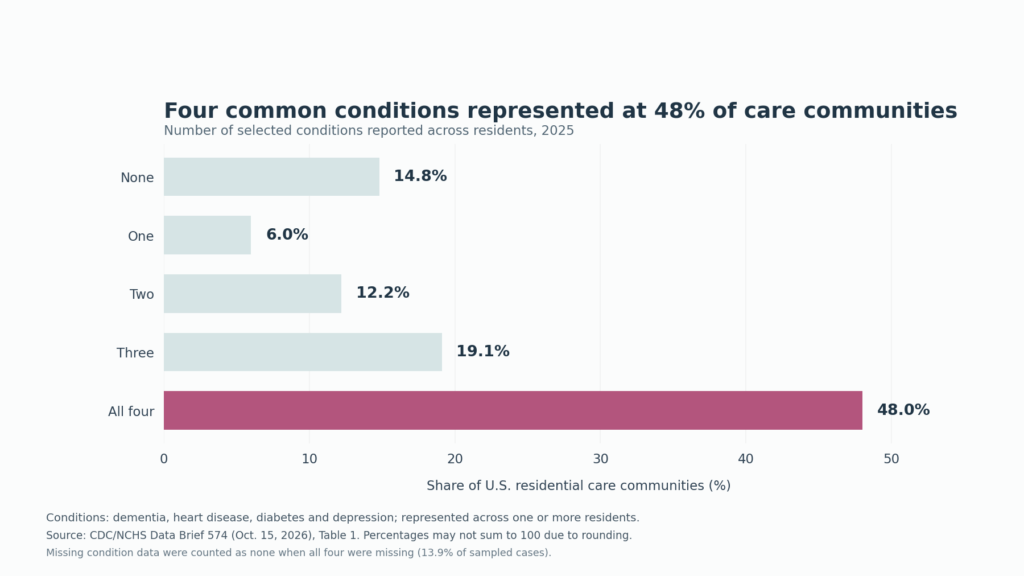
Source: National Center for Health Statistics, National Post-acute and Long-term Care Study, 2025; NCHS Data Brief No. 574, published October 15, 2026. Percentages may not total 100 due to rounding.
What the 48% Finding Actually Means
The NCHS measure counts how many of four specified conditions were reported among any current residents of a residential care community. For example, one resident might have diabetes while another has depression and a third has dementia. A community could therefore have all four conditions represented without any individual having all four. The report estimates that approximately 15,100 communities met this definition in 2025.
That distinction matters for headlines and care decisions. The report does not estimate how many individual residents have multiple conditions or how severe those conditions are. It also does not compare the quality of care at different facilities.
Geography and Community Size Showed Differences
All four conditions were represented at a higher percentage of nonmetropolitan communities (62.4%) than metropolitan communities (45.4%). By region, the corresponding percentages were 64.4% in the Northeast, 57.9% in the Midwest, 44.5% in the South and 41.4% in the West.
Community size also mattered in the descriptive data. Among communities with 4–10 beds, 31.5% reported all four conditions represented, compared with 56.9% for those with 11–25 beds, 65.2% for those with 26–50 beds and 59.0% for those with more than 50 beds. Larger communities may have more opportunities for all four diagnoses to be represented simply because they serve more residents; these figures do not prove why the differences occur.
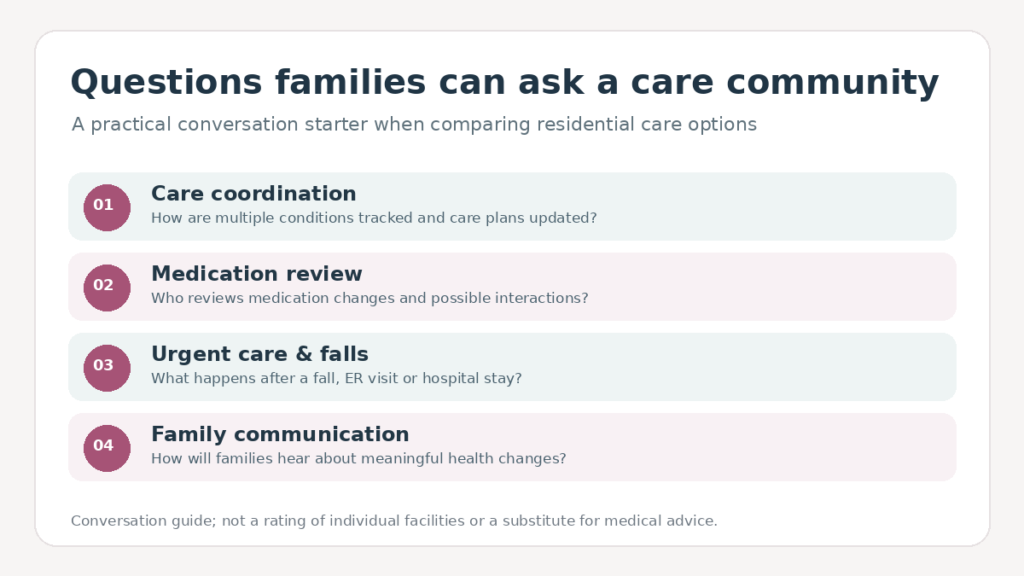
What Families Can Ask When Evaluating Care
For women and families coordinating care for aging relatives, the findings offer a useful starting point for conversations rather than a scorecard for choosing a facility. Practical questions include how staff coordinate care across different diagnoses, who reviews medications, how falls and hospital visits are handled, and how families receive updates when health needs change.
Those questions are general considerations, not recommendations drawn from a trial of care interventions. The NCHS analysis did not test whether a specific staffing model, medication process or family communication practice improves outcomes.
Falls and Hospital Visits Were Associated With More Conditions Being Represented
Communities that reported a resident fall in the previous 90 days were more likely to report all four conditions represented than communities without a reported fall (66.3% versus 31.0%). The pattern was also present for communities reporting emergency department visits (62.0% versus 33.9%) and overnight hospital stays (63.4% versus 40.7%).
These are community-level associations. They do not show that the four conditions caused falls or hospital visits, nor do they establish the risk of any one resident experiencing an adverse event.
About the Data
The analysis is based on the residential care community survey component of the 2025 National Post-acute and Long-term Care Study (NPALS), a nationally representative survey of eligible U.S. residential care communities. Eligible communities were state regulated, had at least four licensed or certified beds, served predominantly adults, provided room and board with at least two meals daily, offered around-the-clock on-site supervision and help with personal or health-related care, and had at least one current resident. NCHS estimated approximately 31,400 such communities serving roughly one million residents on a given day in 2025.
The data are reported by communities, not collected as individual medical records for every resident. The four-condition measure counts whether each selected diagnosis was represented among one or more current residents. Missing information is a limitation: 13.9% of sampled community cases lacked data for all four conditions and were included in the “none” category for the distribution in the report. Missingness for individual variables ranged as high as 19.4%. Survey weighting and statistical methods were used to account for the study design. The findings describe associations, not causation, individual disease prevalence, care quality or future health outcomes.
Sources
- CDC/NCHS: Chronic Conditions in Residential Care Communities: United States, 2025 (Data Brief No. 574, October 15, 2026)
- CDC/NCHS: Original data brief and methodology (PDF)
- CDC/NCHS: National Post-acute and Long-term Care Study (NPALS)
About Women’s Health & Diet: Women’s Health & Diet publishes evidence-informed nutrition, fitness and wellness information for women and families, translating public health research into accessible context for everyday decisions.