Nearly Half of U.S. Women Ages 18–44 Miss Both Major Exercise Targets
New CDC data suggest most U.S. women ages 18–44 are not meeting both major federal exercise recommendations, with muscle-strengthening activity standing out as a particularly large gap.
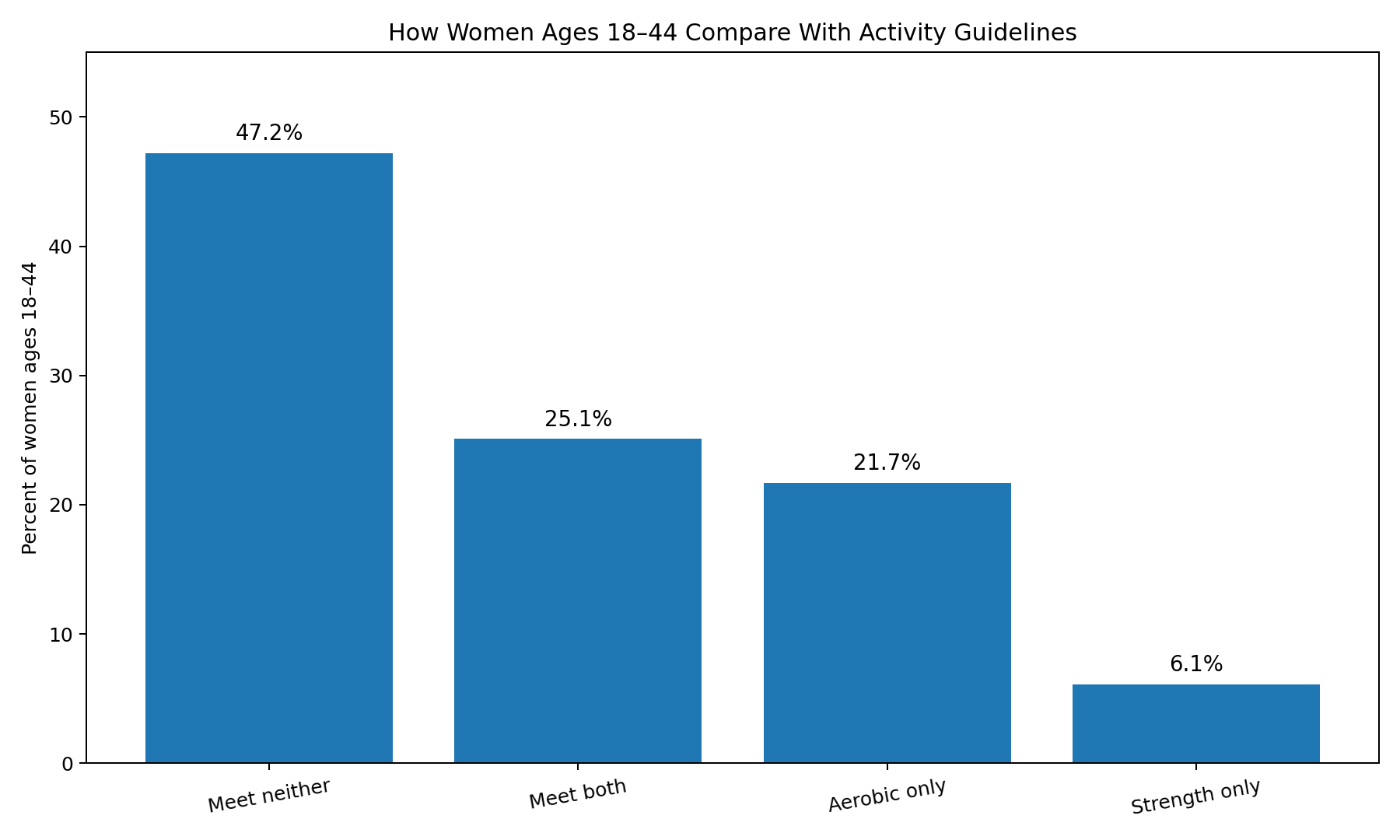
Nearly half of U.S. women ages 18–44 reported leisure-time physical activity that met neither the aerobic nor the muscle-strengthening recommendation, according to a CDC analysis of National Health Interview Survey data from 2022 and 2024.
Only about one in four women in this age group reported meeting both recommendations. The findings do not mean women must spend hours in a gym, but they do highlight an opportunity to make strength work a more visible part of everyday fitness conversations.
- 47.2% met neither the aerobic nor the muscle-strengthening recommendation.
- 25.1% met both recommendations.
- 21.7% met the aerobic recommendation only.
- 6.1% met the muscle-strengthening recommendation only.
- 55.3% reported no muscle-strengthening activity.
Source: CDC MMWR analysis of the 2022 and 2024 National Health Interview Survey.
Why This Matters
Federal physical activity guidance for adults calls for at least 150 to 300 minutes of moderate-intensity aerobic activity each week, or the vigorous-intensity equivalent, plus muscle-strengthening activity on at least two days a week. The CDC report found that many women are reaching only part of that mix, or neither part at all.
Aerobic activity and muscle-strengthening activity support different but complementary aspects of health. Strength-focused exercise can contribute to muscle and bone health and can help preserve lean mass during weight loss, while aerobic activity supports cardiovascular and metabolic health.
The Bigger Gap May Be Strength Training
The report found that 55.3% of women ages 18–44 reported no muscle-strengthening activity. By comparison, 23.2% reported no moderate-to-vigorous aerobic activity. That difference suggests strength training may be less accessible, less familiar, or simply less prioritized for many women.
What Women Can Do With This Information
For women who are currently inactive, the goal does not have to be an all-or-nothing jump to a perfect weekly routine. U.S. physical activity guidance emphasizes that some activity is better than none and that people can build toward the recommended amounts over time.
A practical starting point might be adding two brief strength sessions to an existing walking or cardio routine, using bodyweight movements, resistance bands, dumbbells, or machines. The best routine is one that fits a woman’s schedule, fitness level, access to equipment, and health needs.
Get a personalized Women’s Health & Diet plan designed around your goals, schedule, food preferences, and fitness level.
About the Data
This article is based on the CDC MMWR report Leisure-Time Physical Activity Among Women of Reproductive Age — United States, 2022 and 2024. Researchers combined the two most recent National Health Interview Survey years with physical activity data to improve the precision of national estimates.
After excluding respondents with missing activity or education data, the analytic sample included 10,891 women ages 18–44, weighted to represent approximately 56.1 million U.S. women in that age range. Activity was self-reported and measured leisure-time activity only, so the estimates do not capture every form of movement, including occupational activity. Self-reporting can also be affected by recall or social-desirability bias. The results describe population patterns and do not establish that any one activity pattern caused a particular health outcome.
Sources
- CDC MMWR: Leisure-Time Physical Activity Among Women of Reproductive Age — United States, 2022 and 2024
- U.S. Department of Health and Human Services: Physical Activity Guidelines for Americans
About Women’s Health & Diet: Women’s Health & Diet publishes practical, evidence-informed content on women’s nutrition, fitness, weight management, and everyday wellness.