5 Best Exercises for Women to Build Strength, Boost Energy, and Stay Healthy
Stronger Every Day: Exercise Is One of the Best Gifts You Can Give Yourself
Not only is exercise about changing how you look—it’s also about changing how you feel.
For many women, daily life is filled with responsibilities. Between work, family, household tasks, and everything else on your to-do list, it’s easy for your own health to fall to the bottom of the priority list.
Regular physical activity can improve far more than your appearance. It supports heart health, strengthens bones, improves mood, boosts energy, promotes better sleep, and helps you stay independent as you age.
The best part?
You don’t need to spend hours in the gym or follow complicated workout routines to experience the benefits. A few well-chosen exercises performed consistently can strengthen your entire body while supporting long-term health.
Whether you’re just beginning your fitness journey or looking to improve your current routine, these five exercises deserve a place in your weekly workout plan.
Why Strength Training Matters for Women
A lot of women worry that lifting weights will make them bulky or too muscular. In reality, strength training helps women build lean muscle, improve metabolism, strengthen bones, and enhance everyday movement.
After age 30, women naturally start losing muscle mass. Hormonal changes during perimenopause and menopause can speed up this process. Incorporating resistance exercises into your routine helps preserve muscle while supporting healthy aging.
Benefits include:
- Improved bone density
- Increased strength
- Better balance and coordination
- Enhanced posture
- Improved insulin sensitivity
- More energy throughout the day
- Greater confidence
Let’s explore five of the most effective exercises for women.
- Goblet Squats
Goblet squats are one of the best lower-body exercises because they strengthen several major muscle groups at the same time.
Muscles Worked
- Glutes
- Quadriceps
- Hamstrings
- Core
- Lower back
How to Perform a Goblet Squat
- Hold a dumbbell or kettlebell close to your chest.
- Stand with feet about shoulder-width apart.
- Brace your core.
- Push your hips back and bend your knees.
- Lower until your thighs are parallel to the floor or as low as comfortable.
- Press through your heels to return to standing.
Beginner Recommendation
- 3 sets
- 10–12 repetitions
Benefits
- Builds lower-body strength
- Improves mobility
- Supports better posture
- Helps strengthen the core
- Mimics everyday movements like standing and sitting
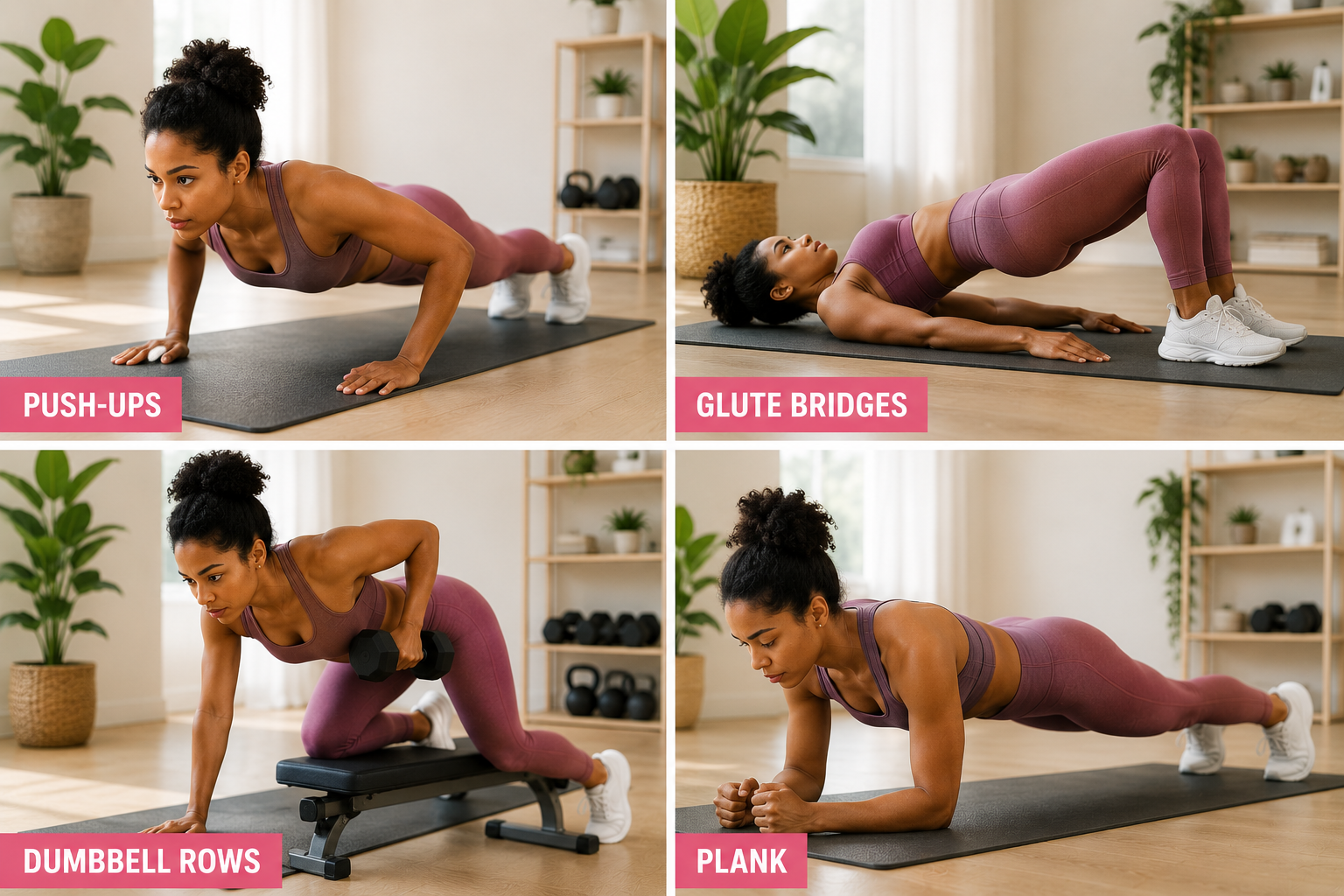
- Push-Ups
Push-ups are one of the most effective bodyweight exercises.
If traditional push-ups feel difficult, begin with wall push-ups or knee push-ups before progressing.
Muscles Worked
- Chest
- Shoulders
- Triceps
- Core
How to Perform
- Place hands slightly wider than shoulder-width.
- Keep your body in a straight line.
- Lower your chest toward the floor.
- Push yourself back up.
Beginner Recommendation
- 3 sets
- 8–12 repetitions
Benefits
- Builds upper-body strength
- Strengthens the core
- Improves shoulder stability
- Requires no equipment
- Glute Bridges
Strong glutes are important for posture, walking, climbing stairs, and reducing lower back discomfort.
Muscles Worked
- Glutes
- Hamstrings
- Core
How to Perform
- Lie on your back.
- Bend your knees.
- Place feet flat on the floor.
- Press through your heels.
- Lift your hips until your body forms a straight line.
- Squeeze your glutes at the top.
- Slowly lower.
Beginner Recommendation
- 3 sets
- 12–15 repetitions
Benefits
- Strengthens the hips
- Supports lower back health
- Improves pelvic stability
- Excellent for beginners
- Dumbbell Rows
Many women spend hours sitting at desks or looking down at phones. Dumbbell rows help strengthen the upper back and improve your posture.
Muscles Worked
- Upper back
- Lats
- Biceps
- Rear shoulders
How to Perform
- Hold a dumbbell in one hand.
- Hinge slightly at the hips.
- Support yourself with your opposite hand.
- Pull the dumbbell toward your rib cage.
- Slowly lower.
- Repeat on the other side.
Beginner Recommendation
- 3 sets
- 10–12 repetitions per side
Benefits
- Improves posture
- Reduces rounded shoulders
- Strengthens the back
- Helps with everyday lifting
- Plank
The plank is one of the best exercises for strengthening your entire core without repeated bending of the spine.
Muscles Worked
- Core
- Shoulders
- Glutes
- Lower back
How to Perform
- Place forearms on the floor.
- Extend your legs behind you.
- Keep your body in a straight line.
- Tighten your core.
- Hold without allowing your hips to sag.
Beginner Recommendation
- Hold for 20–30 seconds
- Repeat 3 times
Benefits
- Improves balance
- Strengthens the core
- Protects the lower back
- Enhances stability
Weekly Beginner Workout
You can perform these exercises at home or in the gym.
Monday
- Goblet Squats
- Push-Ups
- Plank
Wednesday
- Glute Bridges
- Dumbbell Rows
- Plank
Friday
- Goblet Squats
- Glute Bridges
- Push-Ups
- Dumbbell Rows
- Plank
Aim for 30–45 minutes per workout.
Tips for Success
Focus on Form
The Proper technique is more important than lifting heavy weights. Learning good movement patterns helps reduce the risk of injury.
Progress Gradually
Increase your weight or repetitions slowly over time as your strength improves.
Don’t Skip Recovery
Your muscles grow stronger during recovery, not just during exercise. Aim for at least one day of rest between strength-training sessions targeting the same muscles.
Stay Hydrated
Drink water before, during, and after your workouts to support performance and recovery.
Eat Enough Protein
Protein helps repair and build muscle after exercise. Include protein-rich foods such as Greek yogurt, eggs, chicken, fish, beans, tofu, or cottage cheese as part of a balanced diet.
Frequently Asked Questions
Will lifting weights make me bulky?
For most women, no. Women naturally have much lower testosterone levels than men, making it difficult to build large amounts of muscle. Strength training typically helps women develop a leaner, stronger appearance.
How many days per week should women strength train?
The general recommendation is at least two full-body strength-training sessions per week, though many women benefit from three sessions combined with regular walking or other forms of cardiovascular activity.
Can beginners do these exercises?
Yes. Every exercise can be modified to match your current fitness level. Start with lighter weights or bodyweight movements and gradually increase the challenge as you become stronger.
What if I don’t have dumbbells?
Household items such as a backpack filled with books or water bottles can provide resistance. Resistance bands are another affordable option that works well for many of these exercises.
Final Thoughts
Exercise doesn’t have to be complicated to be effective.
Consistency matters far more than perfection. Even a few sessions each week can improve your strength, energy, balance, and overall health over time.
The five exercises in this article—Goblet Squats, Push-Ups, Glute Bridges, Dumbbell Rows, and Planks—provide a strong foundation for women of nearly every fitness level. Together, they strengthen the major muscle groups, improve functional movement, and support healthy aging.
Remember that fitness is a journey, not a race. Celebrate small victories, stay consistent, and focus on becoming stronger—not just physically, but mentally as well.
Disclaimer: This article is for educational purposes only and is not a substitute for professional medical advice. Consult your healthcare provider before starting a new exercise program, especially if you have an injury, chronic health condition, or are pregnant.